From Forum Chaos to Product Clarity
Compressing discovery into a two-week growth strategy sprint
7 min read
At a glance
- Role
- Growth Strategy Consultant (via Amdocs / Stellar Elements)
- Problem
- Strong niche value, unclear scale path
- Solution
- AI-assisted market research, pricing, onboarding roadmap
- Impact
- Strategy delivered in 2 weeks

TL;DR
Some growth problems are not "optimize the button." They are "we don't yet understand what the next audience values, what they would pay for, and what they need to experience before they believe."
A consumer subscription mobile app needed to scale beyond early adopters. The team had a strong core product for a specific kind of user, but lacked a clear model for broader growth, subscription packaging, and onboarding priorities.
I built a rapid intelligence workflow combining AI-assisted qualitative research and competitive analysis, then translated insights into pricing/packaging direction and a prioritized onboarding roadmap.
Impact:
- Delivered strategy and recommendations in 2 weeks.
- Defined subscription packaging and positioning direction.
- Produced a prioritized onboarding and experimentation backlog.
"I've seen too many pitches and decks from consultants to count. This was easily top 3, if not the best I've seen...I'm blown away by how well you guys understand our business and customers."
— Senior stakeholder at the company
Context
In consumer subscriptions, scaling beyond early adopters often fails for a basic reason: the value that power users feel is not obvious to a new user on day one.
This company had captured roughly 2.5% of its addressable market — which maps almost exactly to the innovator/early-adopter segment on the adoption curve. The product was strong for expert users who already understood the domain. But growth had stalled, and the team believed they'd saturated their audience. Three forces were compounding the problem: a post-ZIRP funding environment tightening budgets, a dominant competitor pulling ahead on brand and distribution, and no clear strategy for reaching the next wave of users.
In this domain, there's an additional layer: community language, identity, and trust signals matter. If onboarding feels generic, users bounce even if the product is differentiated.
Problem
The team needed clarity on three intertwined unknowns:
- What broader users actually value (vs. what early adopters value)
- How to package the product so the subscription feels fair and obvious
- Which onboarding moments drive belief, not just completion
The client's own assumptions about their value proposition were strong — but untested. They believed their core differentiator was a specific data feature that no competitor offered. They believed they had "all the expert users." Both of these turned out to be wrong.
Solution
Decision 1: Build an AI-accelerated research pipeline
We had two weeks for a pitch that needed discovery-phase depth. Instead of treating this as a constraint, I used AI to compress the research cycle without sacrificing rigor.
The pipeline had five channels:
- UX audit — screen-by-screen teardown of the product and its primary competitor, documenting every friction point from download through upgrade
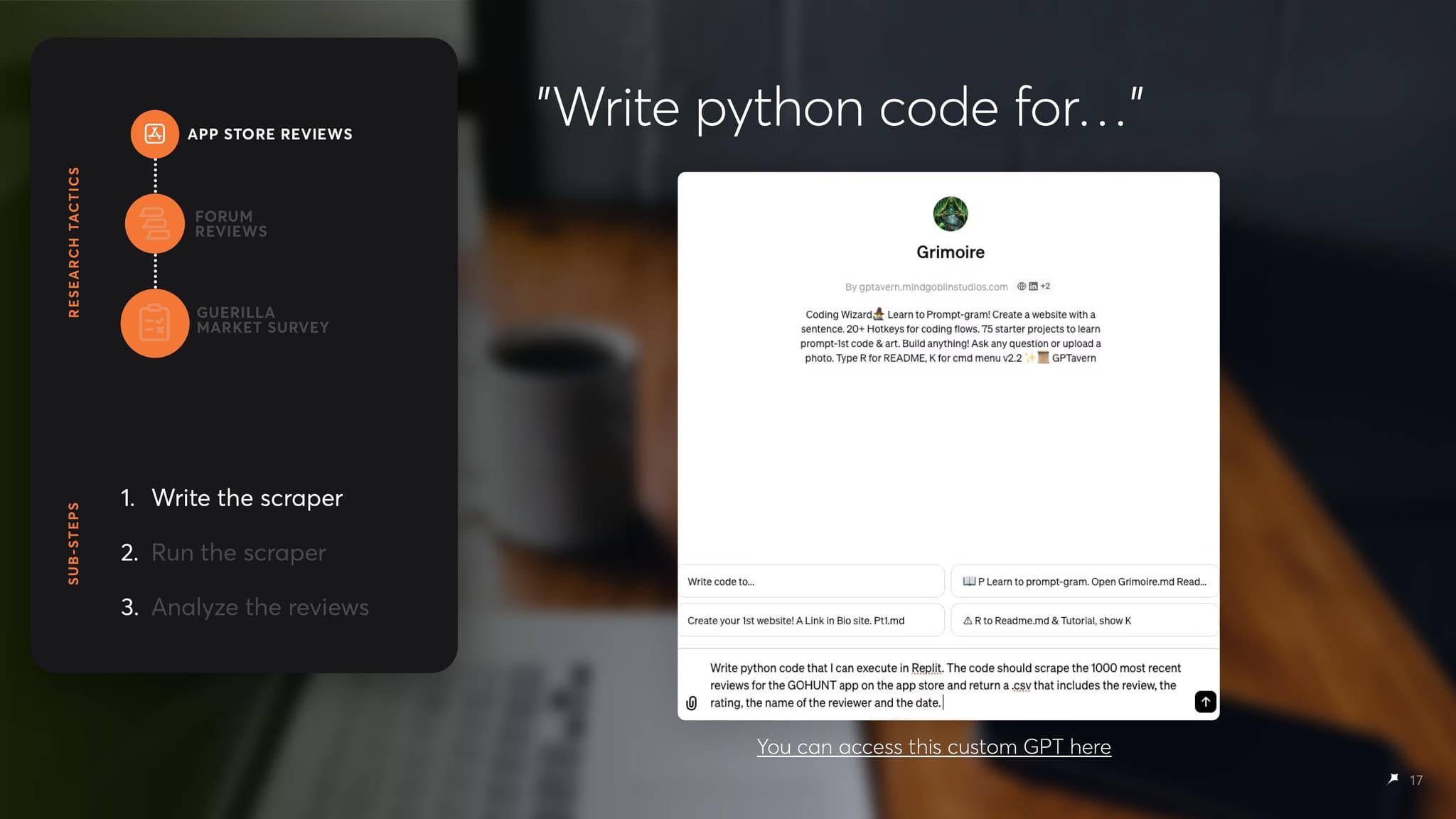
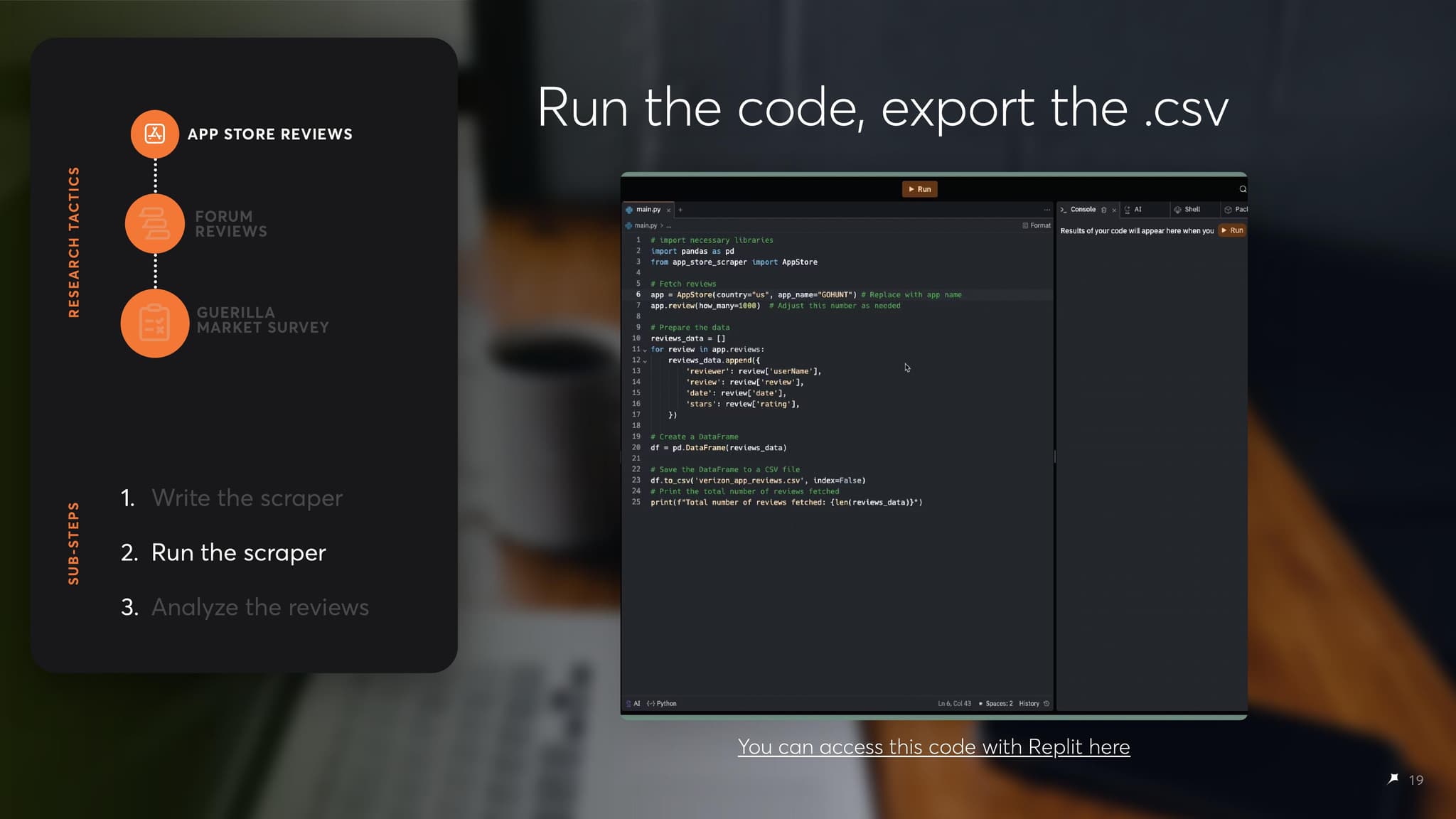
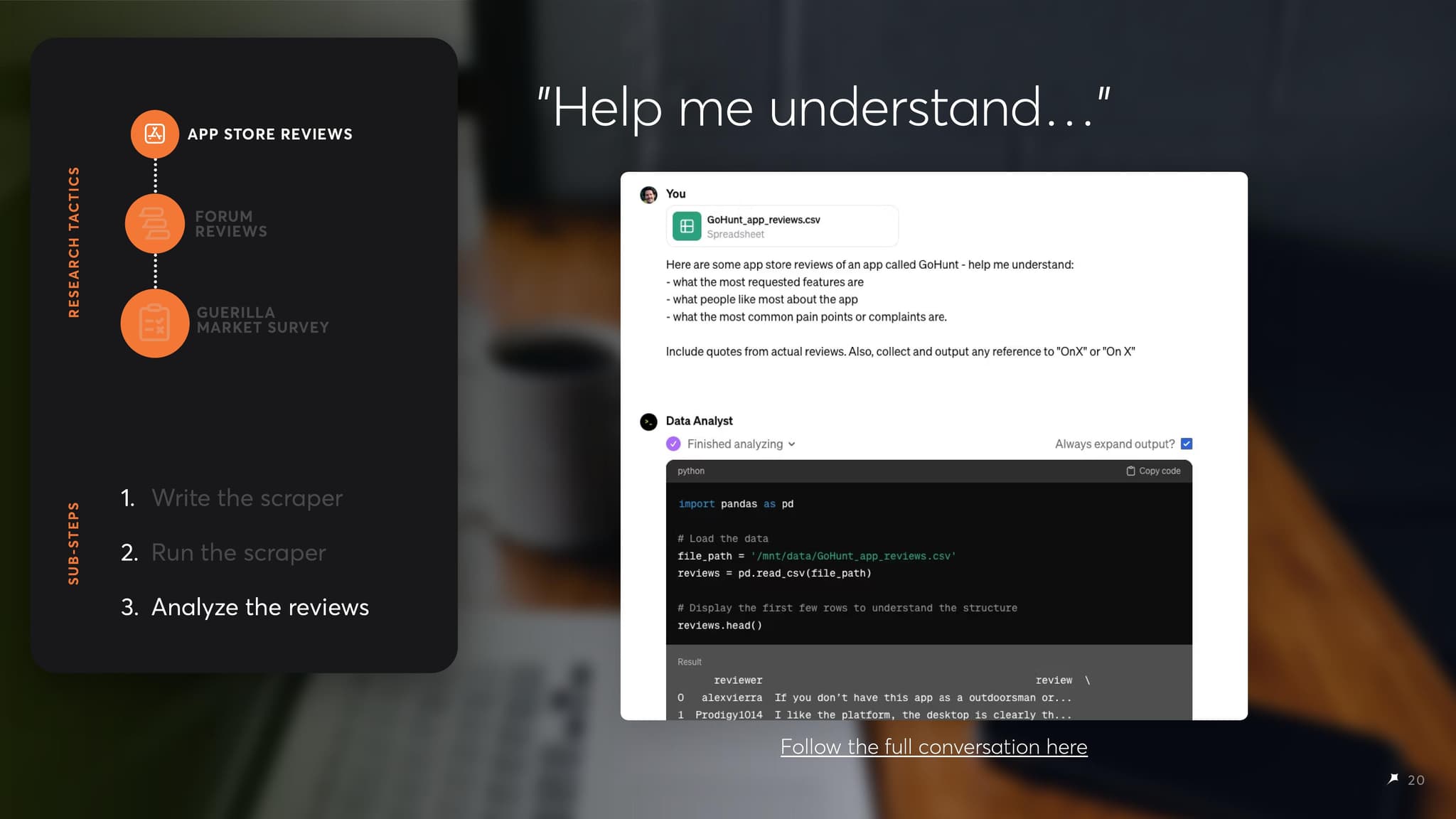
- App store review analysis — I used ChatGPT to write a Python scraper, ran it on Replit to pull thousands of reviews across the product and three competitors, then uploaded the CSV back into ChatGPT's Data Analyst for pattern extraction
- Forum mining — scraped community discussions from Reddit and domain-specific forums, then built a custom GPT loaded with the corpus so the team could interrogate the research conversationally
- Guerrilla survey — designed and deployed a 65-person survey into the target community on zero budget, covering usage patterns, feature value ranking, and willingness to pay
- Market interviews — direct phone and in-person conversations with users in the domain
[BREAKOUT: /media/case-studies/gohunt-ai-acceleration.jpg | Five research channels, three accelerated by AI: app store scraping, forum analysis, and survey design/synthesis]
What the research revealed
Five insights reshaped the strategy:
-
Users want a single tool but always cobble together 2+. 63% of survey respondents used multiple apps on their most recent trip. The stated preference ("Not. Another. App.") and the actual behavior diverged completely.
-
The core differentiator wasn't the entry point. 95.9% of single-tool users chose a mapping-first tool, not the data feature the client considered their moat. Only 25% of respondents used the client's signature feature at all on their last trip.
-
The competitive position was asymmetric. 83% of the client's users also used the dominant competitor. But only 9.2% of all respondents used the client's product at all — and 55.4% used the competitor exclusively. The switching was one-directional.
-
The signature feature was misunderstood. Users perceived the data as commodity — "easier to just download the results and do the analysis in Excel." The feature had real value, but the product failed to make that value legible.
-
Bundled content annoyed more than it attracted. 54% of respondents were frustrated that editorial content was included in subscription pricing. It felt like cost inflation, not added value.
[BREAKOUT: /media/case-studies/gohunt-insight-mapping-vs-odds.jpg | The competitive asymmetry: most of the client's users also used the competitor, but not vice versa]
Decision 2: Pricing and packaging as strategy, not a spreadsheet
I synthesized willingness-to-pay and competitive packaging into concrete recommendations:
- Tier boundaries and feature gates grounded in what users actually valued (mapping) vs. what they tolerated (editorial content)
- A potential lower-price tier without mapping to get users into the ecosystem via ecommerce
- The binary strategic fork: either shed the mapping product or invest seriously to compete — the half-hearted middle was frustrating users and perceived as driving up price
Decision 3: A three-phase growth roadmap
We translated insights into a phased roadmap: Optimization (stop the bleeding), Maximization (expand the value), Evolution (compound the advantage).
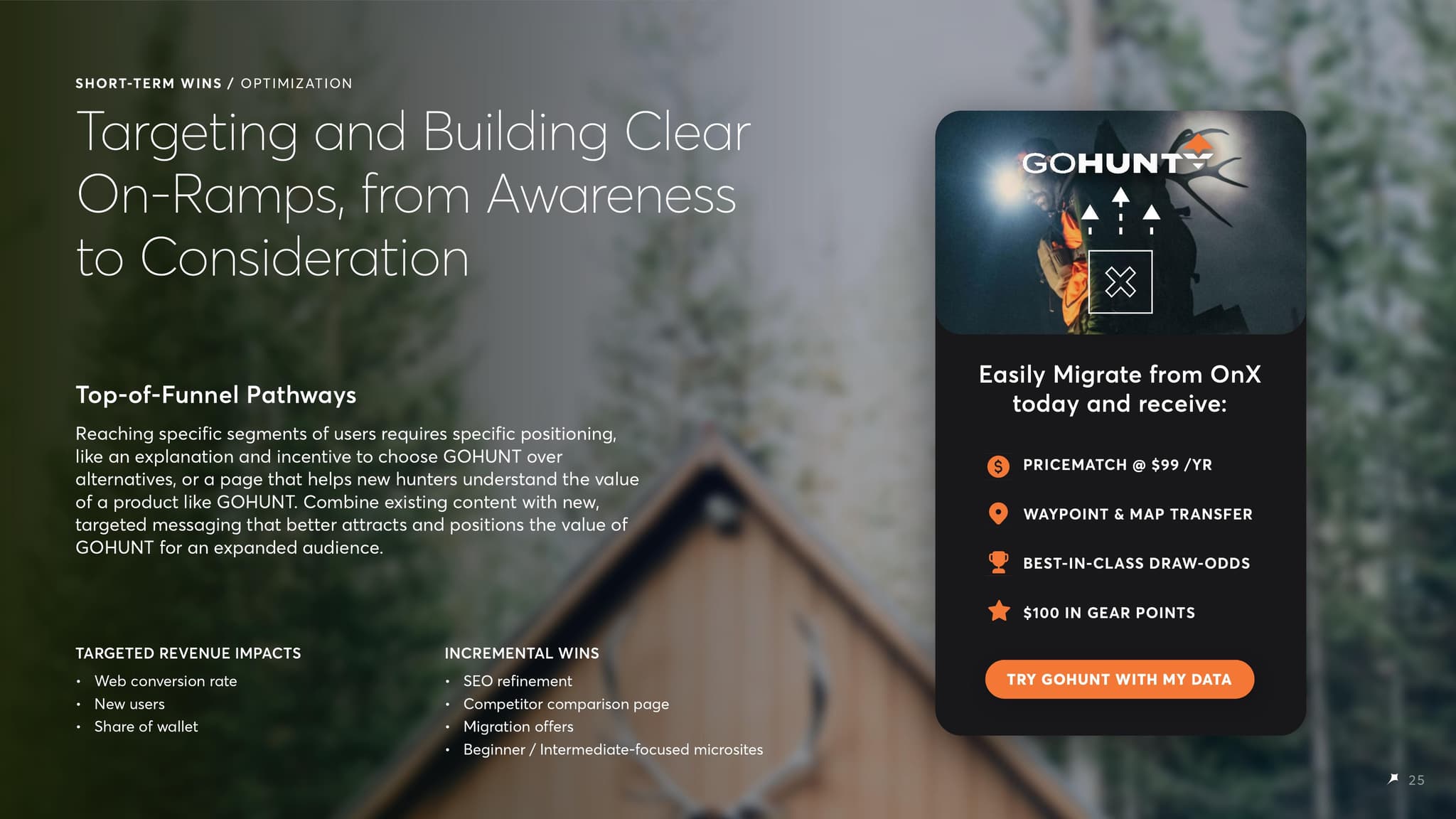
[BREAKOUT: /media/case-studies/gohunt-roadmap.jpg | Three-phase roadmap from quick wins to compounding advantage]
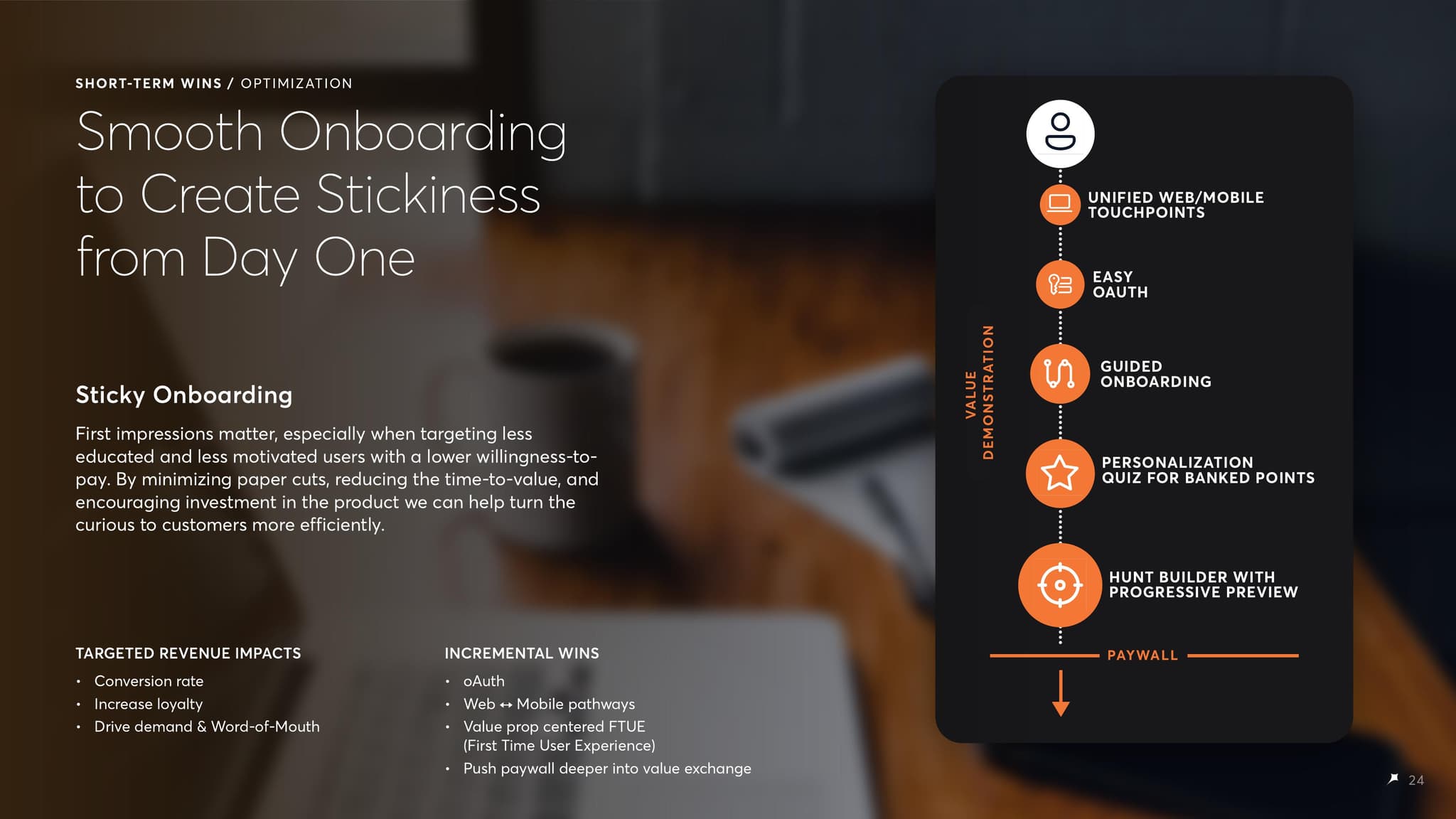
Optimization — low-regret moves to execute immediately:
- Sticky onboarding with OAuth, guided first-time experience, and a paywall pushed deeper into the value exchange
- A competitor migration offer: price match, data transfer, and bonus loyalty points to reduce switching costs
- Top-of-funnel pathways for beginners and intermediate users who didn't know the product existed
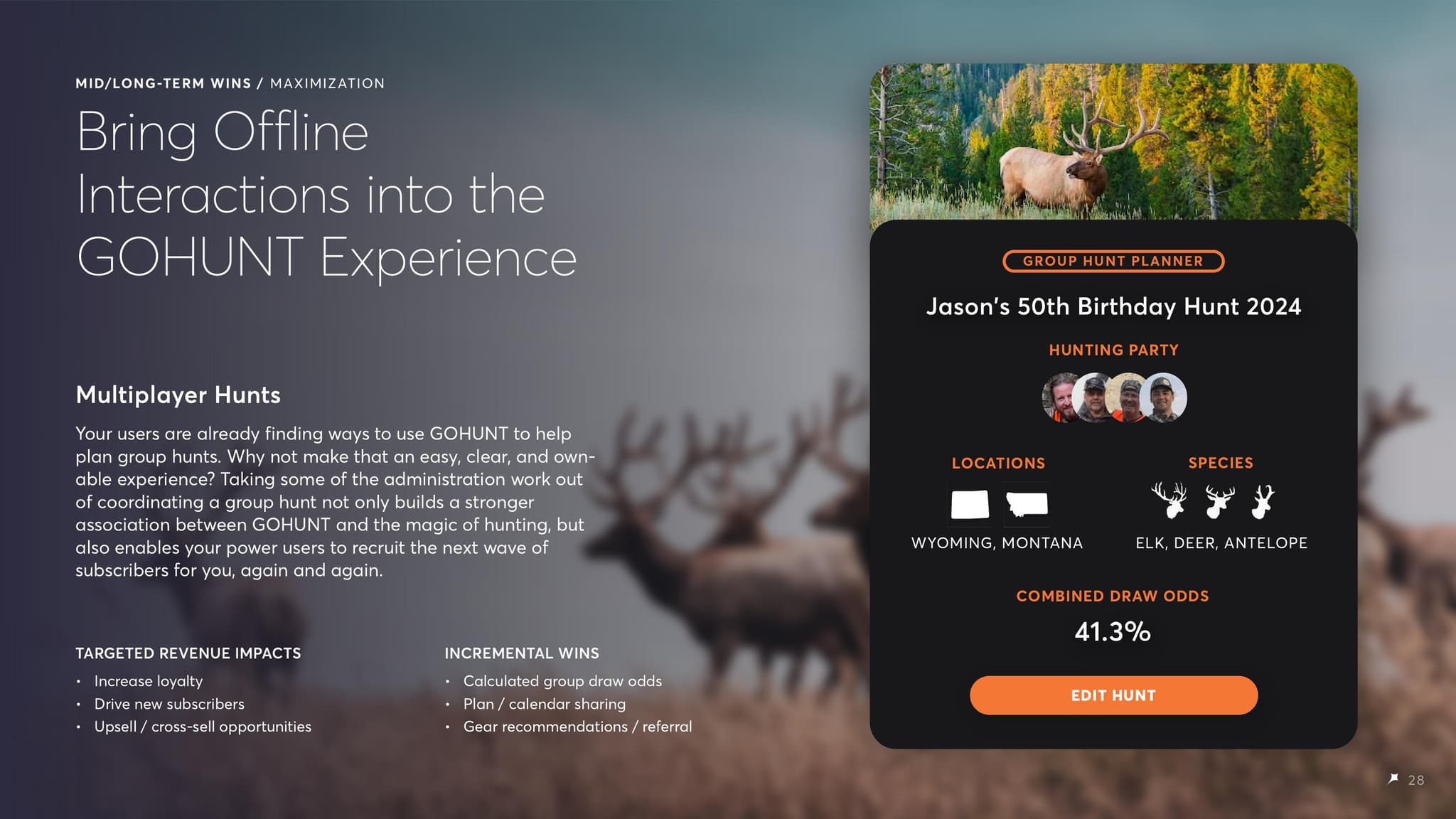
Maximization — expand who the product is for:
- Segmentation and personalization so amateurs and experts get different experiences
- "Multiplayer" group planning features that turn power users into recruiters — each group activity exposes N-1 potential new subscribers to the product
- A community platform with expert advisors and a points-based economy
Evolution — make the growth engine legible:
- A dynamic growth model that disambiguates levers so anyone on the team can diagnose stalled growth, not just the consultant who built the model
Results
The client described the pitch as the best they'd seen from a consultancy. They didn't engage — our rates exceeded their budget. They were simultaneously evaluating a 3-person shop and a solo consultant, which better fit their scale.
The durable outcomes were on our side:
- The AI-accelerated research approach became the team's template for subsequent client pursuits
- The app store scraper I built with ChatGPT was productized on Replit and adopted across the team
- The growth modeling methodology introduced here was refined on later engagements and cited in my annual review as a key contribution
- The custom GPT approach for persona modeling was reused on multiple subsequent projects
The work demonstrated that AI can compress a discovery timeline without sacrificing depth. Two weeks of research, backed by real data from real users, produced insights the client's internal team hadn't surfaced in years — including evidence that directly contradicted their core positioning assumptions.
What I'd Do Differently
I would define a single explicit activation moment earlier: the one thing a new user must experience to feel "I get it." Without that, teams over-invest in generic onboarding completion instead of belief formation.
I'd also challenge the engagement model earlier. The depth of research we brought was calibrated for a larger engagement than the client could afford. Knowing the budget constraint upfront would have let us scope a smaller, faster entry point that could prove ROI before scaling up.
Collaborators
I partnered with a design director and product strategist to translate research into concept mockups and engagement architecture, then shaped recommendations into an execution-ready roadmap with the broader Stellar Elements team.