The Organizational Memory Crisis
Why companies keep relearning the same lessons
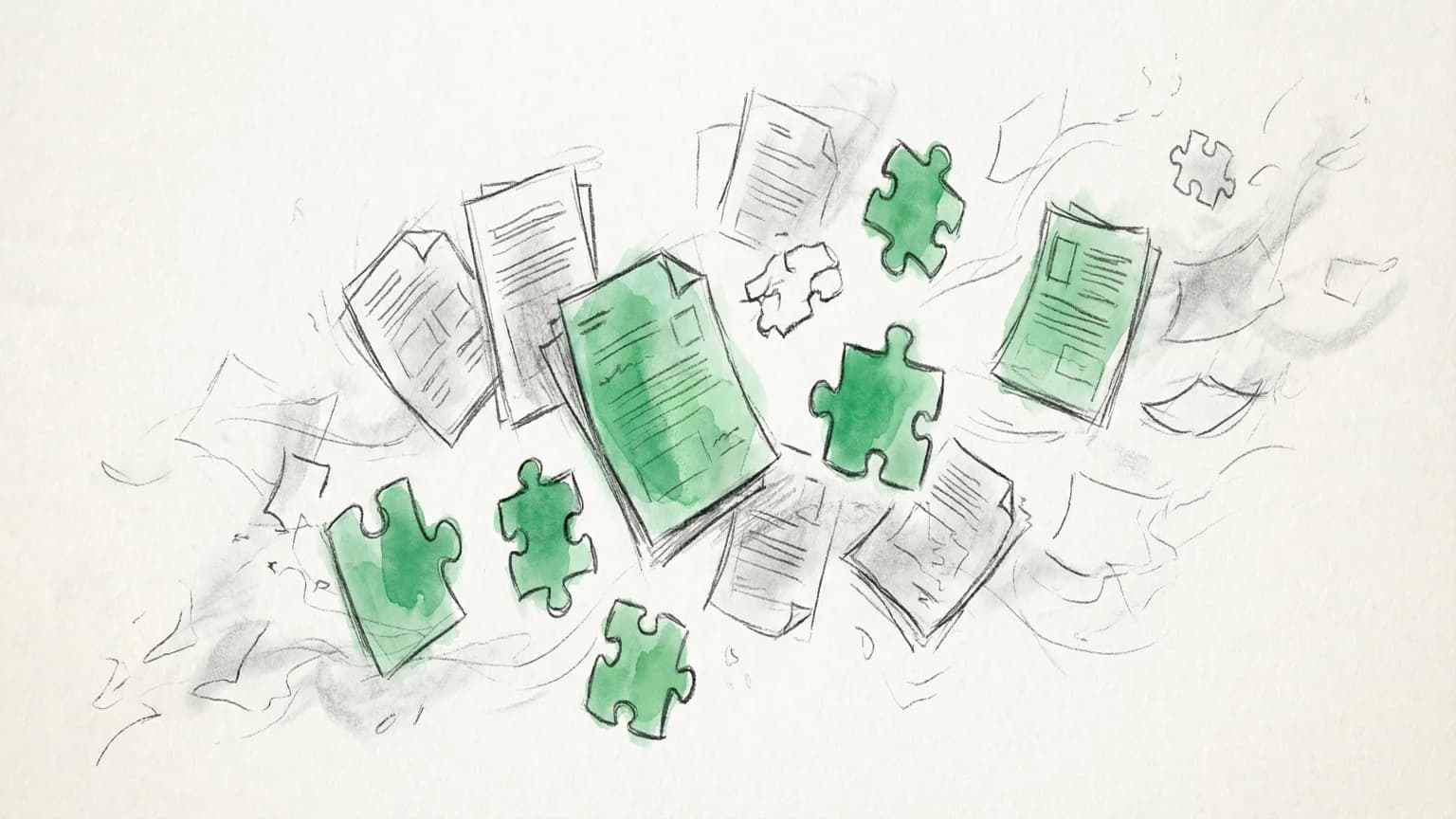
Why companies keep relearning the same lessons
Three months into my work at a major animation studio, I sat in a discovery session about asset search. A director was explaining how long it takes to find reference footage. "Sometimes 15 to 30 minutes just to locate a single clip," she said. "And we're doing this hundreds of times per production."
I wrote it down. We identified the problem, discussed solutions, moved on to other priorities.
Three months later, I was in another meeting. Different team, same studio. Someone raised the issue of asset search times. "Sometimes 15 to 30 minutes," they said. The exact same number. The exact same pain point. Discovered fresh, as if for the first time.
This is what I call the organizational memory problem. And I believe it's costing companies far more than they realize.
The Hidden Cost
When I started tracking discovery debt at the studio, I found the same problems getting "discovered" every 6-8 months. Asset search times. Metadata gaps in the digital library. Communication breakdowns between departments. Each discovery session felt productive. Each produced a document that lived in Confluence for a few weeks, then slowly fossilized.
The direct cost is obvious: duplicate meetings, repeated research, wasted hours. But the real damage runs deeper.
Decisions get unmade. I watched a team debate a workflow change for weeks, reach consensus, implement a pilot. Six months later, with some personnel turnover, the same debate started over. Not because the first decision was wrong, but because nobody remembered it happened.
Institutional knowledge evaporates with every departure. When a senior engineer leaves, they take years of context about why systems work the way they do. The next person inherits the system without the history, makes changes that seem logical in isolation, and breaks things that were carefully designed around constraints they never knew existed.
The worst part? The cost is invisible. Nobody tracks "time spent rediscovering known problems" as a metric. It doesn't show up on any dashboard. It's just friction, everywhere, all the time.
I tried to estimate this once. At the studio, I counted the number of times I heard a problem described as "newly discovered" that I knew had been discussed before. Seven times in three months. Average meeting time: 90 minutes, six people. That's 63 person-hours spent rediscovering things we already knew, in one quarter, in the corner of the organization I could see.
Scale that across a large studio. Assume my corner was representative. The numbers get uncomfortable fast.
Why Wikis Fail
The standard response to this problem is documentation. "Let's build a knowledge base." Every company I've worked with has one. Confluence. Notion. SharePoint. Internal wikis with optimistic names like "Single Source of Truth."
None of them work. And I think I understand why.
Wikis are passive. They require someone to remember the thing exists, navigate to it, find the right page, and hope the information is still accurate. That's a lot of activation energy for knowledge that might not even be relevant to the current question.
Worse, wikis create a maintenance burden without creating a maintenance habit. Someone writes a page during a project. The project ends. The page lingers, slowly drifting from reality as the system it describes evolves. Nobody's job is to keep it current. Eventually, trust erodes. People stop consulting the wiki because the wiki has burned them before.
I've seen this pattern at every company I've worked with. Brand new wiki, lots of enthusiasm, decent adoption for the first three months. Then a slow decline. By month twelve, it's a graveyard of good intentions.
The problem isn't the tool. It's the model. Documentation as a one-time activity can't keep up with organizations that change continuously.
There's a second failure mode I see constantly: the wiki becomes a political artifact rather than a knowledge artifact. Teams document things to create paper trails, not to share knowledge. The documentation serves the author's need to prove they did the work, not the reader's need to learn from it.
At one company, I found four different wiki pages documenting the same integration, written by four different teams over two years. Each page existed because someone needed to show their manager they had "documented the process." None of them referenced each other. Two directly contradicted each other on a key configuration step. All four were technically accurate at the time of writing and wrong by the time I found them.
A Different Approach
Over the past year, I've been building a personal memory system for my AI assistant. It started as a simple experiment: could I make Claude remember my preferences across sessions?
What I built turned into something more interesting. It's a three-stage pipeline that turns raw observations into actionable rules. And I think the same model could work for organizations.
Here's how it works.
Stage 1: Capture. At the end of meaningful work sessions, I generate a diary entry. It records what I worked on, decisions I made, problems I encountered, and preferences I expressed. I have 131 entries now, spanning about four months.
The capture is low-friction. I don't curate or edit. I just dump everything relevant into a timestamped file. The goal is completeness, not polish.
Stage 2: Extract. A weekly reflection process analyzes the diary entries and extracts patterns. If I've mentioned preferring conventional commit formats in three different sessions, that becomes a pattern with a confidence score.
{
  "pattern": "use conventional commit format (feat:, fix:, style:)",
  "confidence": 0.85,
  "occurrences": 12,
  "category": "git",
  "source_diaries": ["2026-01-15-session-2.md", "2026-01-18-session-1.md"]
}
The extraction is automated. I don't manually tag patterns or decide what matters. The system surfaces what recurs.
Stage 3: Promote. Patterns above a confidence threshold (0.7 confidence, at least 3 occurrences) automatically sync to my active instruction set. Claude now knows I prefer Things 3 for tasks, that I hate em dashes in AI-generated text, that I want failing tests written before bug fixes.
The promotion is automatic too. High-confidence patterns graduate into rules without my intervention. Low-confidence patterns stay in observation until they prove themselves.
Why This Works
The key insight is that active curation compounds. Each stage builds on the previous one. Diary entries are raw and numerous. Patterns are refined and fewer. Rules are authoritative and sparse.
Passive wikis try to skip straight to the rules. Someone writes down "how we do X" without the underlying observation and extraction that would make the rule durable. The rule might be wrong from the start. Or it might be right today but wrong next month when circumstances change.
My system catches drift automatically. If I start doing something differently, new diary entries reflect that change. Eventually, the old pattern's confidence score drops as it stops appearing. New patterns emerge to replace it.
It also handles contradictions gracefully. Sometimes I make decisions that conflict with previous decisions. That's fine. The reflection process notes the contradiction, and if the new approach persists, it replaces the old rule. The system doesn't assume past decisions are permanently correct.
The biggest surprise: the system caught preferences I didn't consciously know I had. After a few weeks, patterns emerged that I wouldn't have thought to document. Small things, like how I prefer verbose error messages during development but terse ones in production. The system noticed before I did.
Here's a concrete example of the self-correcting loop. Early in the year, Claude would sometimes edit stakeholder quotes during editorial passes. Changing words, tightening phrasing. From a pure writing quality perspective, the edits were often improvements. But I didn't want that. Those were someone else's words.
The first time it happened, I corrected it in the session. The correction got captured in that day's diary entry. A few weeks later, the reflection process extracted a pattern: "user corrects modifications to stakeholder quotes." That pattern hit the confidence threshold and became a rule: "NEVER modify user/stakeholder quotes during editorial passes."
Now Claude knows. Not because I wrote a style guide, but because the system observed what I actually do and promoted that observation into policy.
The self-correcting aspect matters. I could have written that rule manually on day one. But I wouldn't have. It's not the kind of thing you think to document until you've been burned. The capture-extract-promote pipeline creates the rule from the burn itself.
Translating to Organizations
If this works for one person, could it work for a team? I think so, with some adaptations.
Capture at the edges. In organizations, the raw material lives in meeting notes, Slack threads, support tickets, and postmortems. The challenge is aggregating it without creating more work. The best capture systems are passive: they record what's already being said rather than asking people to say it again for documentation purposes.
When I was at the studio, I started keeping personal notes on every discovery conversation. "Director mentioned 15-30 minute search times for archival footage." "Layout department wants better handoff from story." "Producer concerned about visibility into downstream dependencies."
These notes were for me, not for any official system. But they accumulated. And when the same topic came up again, I had the receipts. "We discussed this in March. Here's what was decided."
Extract through synthesis. Someone needs to read the raw material and find the patterns. This used to be expensive. With language models, it's now cheap. You can feed months of meeting notes to a model and ask: "What problems keep coming up? What decisions keep getting revisited?"
The output won't be perfect. But it doesn't need to be. It needs to surface candidates for human review. "We've mentioned asset search times in 14 different meetings over the past year" is a flag worth investigating, even if the model occasionally miscounts.
Promote deliberately. The final stage requires human judgment. Not everything that recurs should become policy. Sometimes problems recur because they're genuinely hard, not because the organization forgot the solution.
But a pattern that appears five times deserves a response. Either solve the problem, or explicitly decide not to solve it. The worst outcome is rediscovering the same problem repeatedly without that recognition changing anything.
The Studio Example
Let me make this concrete with a story from my time at the animation studio.
When I joined as a consultant, the studio had no standardized way to measure content operations. Different departments tracked different metrics. Nobody could answer basic questions like "how long does it take to process an asset from ingest to delivery?" or "what's our current throughput versus target?"
In discovery sessions, I heard the same complaint from multiple directions. "We don't know what our numbers mean." "Every team measures differently." "We can't compare quarter over quarter because the definitions keep changing."
I built a metrics framework. It defined standard terms, established baseline measurements, and created dashboards that let leaders track performance consistently. The framework got adopted studio-wide. Leadership endorsed it. It became the official way the studio measures content operations.
But here's what I didn't anticipate: the framework itself was organizational memory. By encoding "this is what throughput means" and "this is how we count processing time," the definitions persisted even as people rotated through roles. New hires didn't need to rediscover how to measure things. The framework already captured the institutional knowledge.
The DVD digitization insight is a good example. During discovery, I learned that searching for archival footage on DVDs took 15-30 minutes per search. Multiply by hundreds of searches per production, and it's a significant time sink.
That number got captured in the metrics framework documentation. Not as a KPI to track, but as a baseline reference. "Before digital search, asset discovery averaged 15-30 minutes." When someone new joins and asks why the digital library project was prioritized, the answer is right there. No need to rediscover the pain.
The metrics framework succeeded where previous documentation efforts failed because it had a forcing function. People had to use it to report their numbers to leadership. That meant they had to consult it regularly. That meant they noticed when it drifted from reality. That meant they updated it.
Passive documentation dies because nobody needs it badly enough to maintain it. Active documentation survives because something depends on it being right.
This is the same dynamic that makes code outlast process docs. Code has a forcing function: if it's wrong, things break. Process docs have no such forcing function. If they're wrong, people just work around them.
The goal of organizational memory isn't to create more documentation. It's to create documentation with forcing functions. Rules that get used. Definitions that get referenced. Baselines that get compared against.
The Implementation Challenge
I won't pretend this is easy to implement. Organizations have inertia. People have existing workflows. Adding a capture-extract-promote pipeline sounds like creating more work when everyone already feels overwhelmed.
But I think the cost of not doing this is higher than the cost of doing it. And the cost of doing it keeps dropping as language models get cheaper and better.
Here's a minimal version that any team could start tomorrow:
-
Shared notes doc for recurring meetings. Not detailed minutes. Just a running log of "things we discussed" with dates. Takes five minutes per meeting.
-
Quarterly synthesis. Once a quarter, someone (or something) reads the log and writes up: "Here are the topics that came up more than twice." Twenty minutes of human review time.
-
Decision log. When you make a decision about a recurring topic, write it down somewhere findable. "We decided to delay the asset library project until Q3 because of budget constraints." One sentence.
That's it. You're not building a sophisticated knowledge management system. You're just creating the raw material for organizational memory. The capture.
Over time, you can add extraction (automated pattern detection) and promotion (rules that get incorporated into onboarding or process docs). But even the basic version helps. At minimum, when someone raises a topic that's been discussed before, someone else can say "let me check the notes" instead of starting from scratch.
The key is starting with capture. Extraction and promotion can come later. But without capture, there's nothing to extract from.
I've seen teams try to skip straight to "let's document our decisions" without building the capture habit first. It fails. You can't decide what to document until you've observed what recurs. You can't observe what recurs until you're recording observations.
Start with a messy log. Let it accumulate for three months. Then look at it and ask: what keeps coming up? That question is the extraction. The answer tells you what to promote.
The Role of AI in All This
I should address the obvious: I've been building my memory system with AI, and I'm proposing organizations do the same. Is this just AI hype applied to a boring ops problem?
I don't think so. The problem has existed forever. What's changed is the cost of the solution.
Before language models, extraction required human readers. Someone had to go through months of meeting notes and find patterns manually. That person was expensive. Their time was better spent on other things. So nobody did it.
Now, extraction costs cents. You can process a year of meeting notes for less than a cup of coffee. The economics have flipped.
The same applies to capture. Transcription used to require humans or expensive software. Now it's essentially free. You can record every meeting and have a searchable transcript within minutes.
This doesn't make the organizational memory problem easy. But it removes the economic excuse. We couldn't afford to do this before. Now we can. The question is whether we will.
What I'm Still Figuring Out
I don't have this fully solved. My personal system works well for one person's preferences. Scaling to a team adds complications.
Who owns the extraction? In my system, I review the patterns. In an organization, someone has to decide which patterns are signal and which are noise. That's a judgment call, and judgment calls create bottlenecks.
How do you handle disagreement? My system assumes I'm consistent with myself. Organizations contain multitudes. Two people might have conflicting preferences about the same thing. The system needs a way to surface those conflicts rather than papering over them.
Where do you draw the boundary? Not everything should be remembered. Some decisions are intentionally ad-hoc. Some context is intentionally ephemeral. The system needs to distinguish between "we keep rediscovering this because we forgot" and "we keep discussing this because circumstances change."
These are hard problems. But I think they're worth working on because the alternative is accepting permanent organizational amnesia as normal.
How do you measure success? My system tracks confidence scores and occurrence counts. For organizations, those metrics exist but don't mean the same thing. What does it mean for an organizational pattern to have "high confidence"? I'm not sure yet.
One proxy I've been thinking about: time to answer. When someone asks "have we discussed this before?" how long does it take to find out? If the answer is "I don't know, let me ask around," you have a memory problem. If the answer is "yes, here's the decision from March," you don't.
Another proxy: onboarding time. New hires in well-documented organizations get productive faster. Poorly-documented organizations create long ramp-up periods while new people rediscover the tribal knowledge that veterans carry in their heads.
Neither of these is perfect. But they're measurable, and they point in the right direction.
The Real Cost
I keep coming back to that discovery session at the studio. Fifteen to thirty minutes to find a single clip. Hundreds of searches per production. The same problem, rediscovered three months apart as if for the first time.
How many times has your organization paid that tax? How many hours have been spent solving problems that were already solved, debating questions that were already decided, learning lessons that were already learned?
The cost doesn't show up in any budget. It shows up as friction. As slowness. As a vague feeling that we've been here before without the receipts to prove it.
Most organizations have accepted this as the cost of doing business. I don't think it has to be.
The technology to build organizational memory systems is finally cheap enough to be practical. Language models can synthesize meeting notes. Vector databases can surface relevant past discussions. The tools exist.
What's missing is the model. We need to stop thinking about documentation as a one-time artifact and start thinking about it as a living system. Capture, extract, promote. Raw observations become patterns become rules.
My personal system now has 131 diary entries, 42 extracted patterns, and 16 active rules. Claude remembers my preferences better than I do. The rules compound. Each session builds on everything that came before.
I want that for organizations. Not because documentation is exciting, but because the alternative is watching the same problems get discovered over and over while the solutions gather dust in Confluence.
The organizational memory problem is real. But it's not inevitable. We just haven't been solving it right.