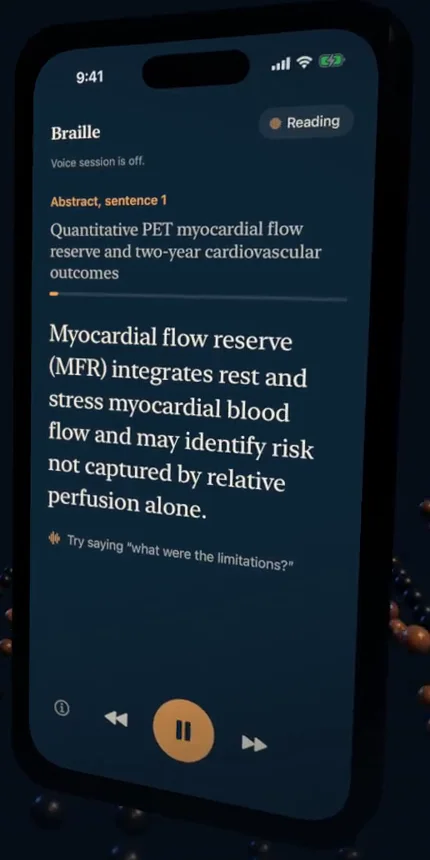
Myocardial flow reserve (MFR) integrates rest and stress myocardial blood flow and may identify risk not captured by relative perfusion alone.
The abstract of Braille’s synthetic test paper, one sentence at a time, in your browser’s voice.
iOS prototype · first pilot not yet run
Scientific papers you can listen to, interrupt and question by voice
Braille was built for a retired nuclear cardiologist with progressive vision loss. He used to read his specialty journals himself, and he wants to keep that command of the literature.
Try it
The reading screen, with a question in the middle
This is Braille’s reading screen rebuilt for the web. Start it, interrupt it with a question, and go back to where you were.
Listening uses your browser’s built-in voice, not Braille’s. This page never uses your microphone.
BrailleStatus: Paused
Quantitative PET myocardial flow reserve and two-year cardiovascular outcomes
From the paper, read word for word
In the app, say “keep reading”.
About this paper
This paper is synthetic. Its authors and findings are invented for testing.
This web preview does not save a reading position. The app saves the paper and the sentence.
Interrupt with a question
In the app you say these. Here, press one. The answer is made of the paper’s own sentences, and your place doesn’t move.
Sample paper. It is the synthetic paper Braille uses for testing, so its authors and findings are invented. The answers here are set in advance from its sentences. In the app, a model picks the sentences.
On the phone
The same loop in the real app
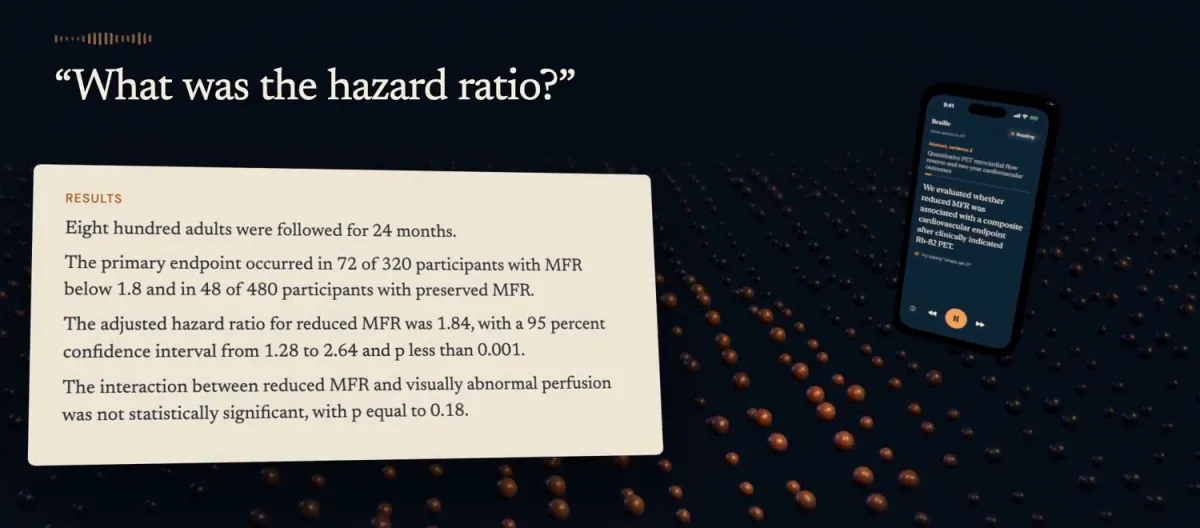
A 38-second film with sound. A retired cardiologist is losing his sight, and the papers keep coming. Braille reads them to him on his iPhone, one sentence at a time. Someone asks “What was the hazard ratio?” and the answer comes from the paper’s own sentences. Then “what’s new in my journals?”, “who cited this?” and “get the full text”. The paper on screen is synthetic.
A frame from the film. The card shows the passage around the answer. The app itself reads back at most three sentences.The reading screen in the app, from the film.
What you can say
The voice does the work. The buttons are a fallback.
The dock above covers reading. Everything else in Braille is spoken.
Readkeep reading, go to results, repeat the numbers
It saves your place. When you reopen the app, the paper waits paused at that sentence. After an interruption it may repeat a sentence rather than skip one you didn’t hear.
Askwhat was the hazard ratio?, who funded this?
Braille reads up to three sentences from the paper, word for word, each labelled by section. If the paper has no answer, it says so.
Keep upwhat’s new in my journals, where does the paper mention flow reserve?
Follow journals and hear what’s new in them. Ask where a term comes up to hear how often, section by section. Compare two papers, each read under its own title and never merged.
Follow citationswho cited this?, open reference 12
Find related papers, hear who cited this one, and open a reference by its number. “Go back to the previous paper” picks it up at the same sentence.
Get the full textget the full text
When only the abstract is free, Braille opens the publisher’s page so the listener or a helper can sign in with their own subscription or library account.
Design
Decisions you just used
Braille is for someone with low vision who listens first and looks second. Each of these is in the reader at the top of the page.
The status is a word, not only a color
The pill reads Reading, Checking the paper or Paused, and VoiceOver hears “Status” and that word. The dot breathes while Braille works and goes still and grey when it pauses.
Your place is held while you hear an answer
The answer tray stops below the position line, so “Paused at” stays in view. Closing it returns to the same sentence. Nothing about the answer moves the reading anchor.
The sentence grows, the dock doesn’t
The sentence is the only large thing on screen, set in a serif. In the app every size follows Dynamic Type. At the largest sizes the dock stops growing, and holding a dock button shows a magnified label instead.
Source and saved place wait in a tray
Where the paper came from, and whether your place is saved, sit behind the details button at the left of the dock. The main screen keeps to the paper.
Four colors, from the app icon
The icon is a braille “b” beside sound waves. The reader on this page uses the same four colors.
Ink#0F2638
Ink raised#173347
Ivory#F7EDDB
Amber#F2A659
Sources
Where every word comes from
Speech recognition runs on the iPhone. No microphone audio or transcript is saved.
A question goes to Braille’s server with the paper’s sentences. The server asks an OpenAI model to pick sentence numbers, and nothing else comes back, so none of the answer’s wording is the model’s.
If the speech server is on, each sentence is also sent to OpenAI to be voiced. Otherwise Apple’s voice reads it on the phone.
Each paper says what it is: synthetic, open full text from PubMed Central, or read through the listener’s own publisher access.
Braille never sees sign-in details and doesn’t try to get past a publisher’s bot check.
The saved place records the paper and the sentence, never the paper’s text, audio or transcripts.
Where it stands
Braille is an iOS prototype. Physical tests have found the voice sometimes cuts off while reading, so it isn’t ready for use without looking at the screen.
Restoring the saved place after the app is force quit hasn’t been checked on a phone yet.
The pilot with the cardiologist it was built for has not run yet, and answer quality on real papers is not yet measured.
 Braille